BIOSECURITY
WHY IT IS MORE THAN IMPORTANT THAN EVER
Written by AKKPS Member Debra Allen of Allen's Acres
"Biosecurity refers to measures aimed at preventing the introduction and spread of harmful organisms (e.g., viruses, bacteria, etc.) to animals and plants to minimize the risk of infectious disease transmission. In agriculture, these measures aim to protect food crops and livestock from pests, invasive species, and other organisms not conducive to the welfare of the human population."
Biosecurity practices on livestock farms and ranches include sanitation, animal management, feed management, facility maintenance, manure handling, and disposal of dead animals. The following is a list of best practices. (Some may not apply to small farms, but you can still learn a lot from these tips)
Sanitation
Employee Sanitation
- Provide on-farm laundry facilities for all employees.
- Encourage employees to wash farm clothing with detergents and bleach.
- Have employees wash their hands before and after milking animals, working with sick animals, and working with young animals.
- Provide gloves when frequent cleaning between animals is necessary.
- Have workers wear some medical exam gloves when helping with births.
- Order tasks so employees work with younger animals before working with older animals. Young animals are susceptible to diseases carried by older animals.
Equipment Sanitation
- Clean and disinfect equipment used on sick animals before using it on healthy animals.
- Clean and disinfect hoof knives, clippers, tattoo pliers, ear taggers, ear notchers, and dehorners between uses.
- Use the farm's halters and clippers whenever possible.
- Sanitize nursing bottles and buckets before each feeding.
- Don't use equipment that has handled manure for transporting or delivering feed.
Vehicle and Transport Sanitation
- Ensure visitor and service vehicles don't drive over feed delivery or manure handling routes.
- Locate holding pens for animal pickups near the road and away from the herd and barn areas.
- Keep visitor vehicles out of places that are accessible to livestock.
- Have visitors move from younger to older animal groups when touring the farm.
- Ensure that truck bedding is clean and ample when moving livestock to prevent injuries and disease.
- Wash and disinfect the outside, inside, and especially the tires of vehicles that transport livestock to other farms.
Boot Cleaning
- Scrub off any visible dirt before thoroughly disinfecting boots.
- Soak boots in a clean solution of disinfectant mixed according to the product's directions.
- Provide disposable booties for visitors and dispose on site.
Animal Management
- Keep animals that are new to the farm in a separate holding area. A quarantine period should be established to facilitate the monitoring and testing of new animals' health status. Quarantining will also help to prevent the spread of diseases to the existing herd from animals that might be harboring a disease without exhibiting any clinical signs.
- Young animals should be kept separate from more mature animals to minimize the exposure of more susceptible animals.
- Keep an isolation area that is intended for only sick animals.
- Meet the standards for pen, stall, or bedded area space per animal in your care.
- Always handle sick animals last.
- Vaccinate farm dogs and cats against rabies to protect humans and animals. Consider vaccinating livestock, too.
- Prevent fence line contact between your livestock and other animals.
- Remove manure, bedding, and disinfect pens between animals, especially maternity and sick pens.
Feed Management
- Keep food storage areas inaccessible to rodents, birds, dogs, cats, and wildlife.
- Repeatedly check for and dispose of moldy or spoiled material in silos, bins, and bunks.
- Place or empty opened bags into containers with tight lids to protect them from pests and water.
- Clean storage areas frequently.
- Remove and dispose of feed refusals if not consumed within 24 hours.
- Store bags of feed off the floor on pallets.
- Rotate feed inventory to reduce the presence of harmful organisms or toxins in stored feeds.
- Clean water once a week.
- Protect all water sources and containers from animal carcasses (e.g., dead birds or vermin) and manure.
Facility Maintenance
- Be wary of rodent dens and hiding places. Set baits and traps where necessary.
- Repair holes in buildings to prevent the entry of pests.
- Check for weather damage and fix anything that needs to be repaired.
- Remove any standing water that can turn into a breeding ground for mosquitoes.
- Check and maintain fences.
- Replace bird netting if required.
Manure Handling
- Ensure the manure handling system prevents environmental contamination and complies with your state's accepted agricultural practices.
- Use equipment to handle manure that is not used for feed.
- Compost or store manure in conditions that destroy disease-causing bacteria.
- Remove manure frequently to prevent the completion of the life cycles of flies and intestinal parasites.
- Store manure so that it is inaccessible to livestock, especially young animals.
- Prevent run-off or transfer of manure from older to younger groups of animals.
- Avoid tracking manure through feed bunks.
Disposal of Dead Animals
- Dispose of carcasses promptly. Options for disposal include calling a licensed deadstock collector, burial in an approved animal disposal pit, or composting.
- Check with local and state authorities regarding disposal regulations in your area.
- Call a veterinarian before disposal if the animal exhibited neurological signs before death.
Disease Transmission
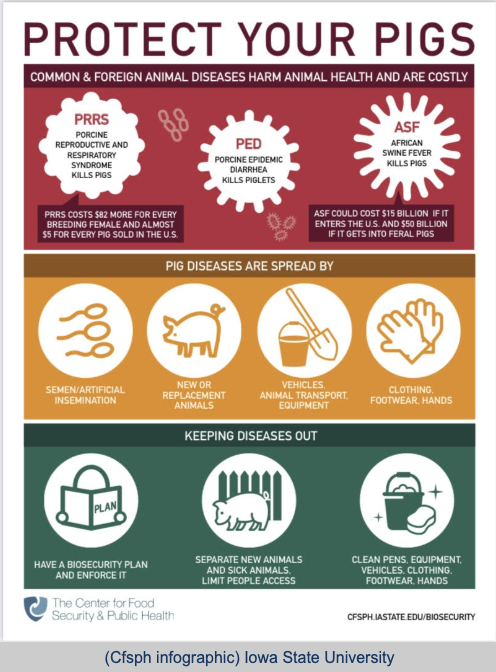
It's critically important to understand disease transmission. There's no better way than the charts found here: https://www.cfsph.iastate.edu/Assets/routes-disease-list-swine.pdf
These charts list the swine diseases and the vectors for transmission. Some terms to know….' Zoonotic' means that disease is transmissible to humans. 'FAD' means foreign animal disease, or in other words, diseases that could be brought into the US.
Understanding how diseases are transmitted is the first step in planning the steps of biosecurity for your farm. Biosecurity can be broken down into Planning, Managing, and Training.
Plans don't have to be complex or elaborate. A plan should describe ways disease could come or be spread on the farm and ways to prevent or manage it.
The first plan piece is animal movement:
https://www.cfsph.iastate.edu/Assets/step1-movement-risks-biosecurity.pdf
Here is a self-checklist to help you get started:
https://www.cfsph.iastate.edu/Assets/step1-movement-risks-biosecurity.pdf
Here is a sample biosecurity plan template:
https://www.cfsph.iastate.edu/Assets/step3-biosecurity-plan-template-swine.docx
Here is the quarantine and isolation tip sheet:
https://www.cfsph.iastate.edu/Assets/tip-sheet-isolation-quarantine.pdf
Here is the Personnel (visitors, employees, family) biosecurity tip sheet:
https://www.cfsph.iastate.edu/Assets/tip-sheet-personnel.pdf
Here is the link to The Center For Food Security and Public Health (Iowa State University) that gives us access to all this information listed above and much more:
https://www.cfsph.iastate.edu/Assets/tip-sheet-personnel.pdf
Please…take the time to investigate the information provided by the CFSPH in the links above. It's critically important as we are going to go into a specific issue that the USDA is now asking all swine registries to pass on to their members.
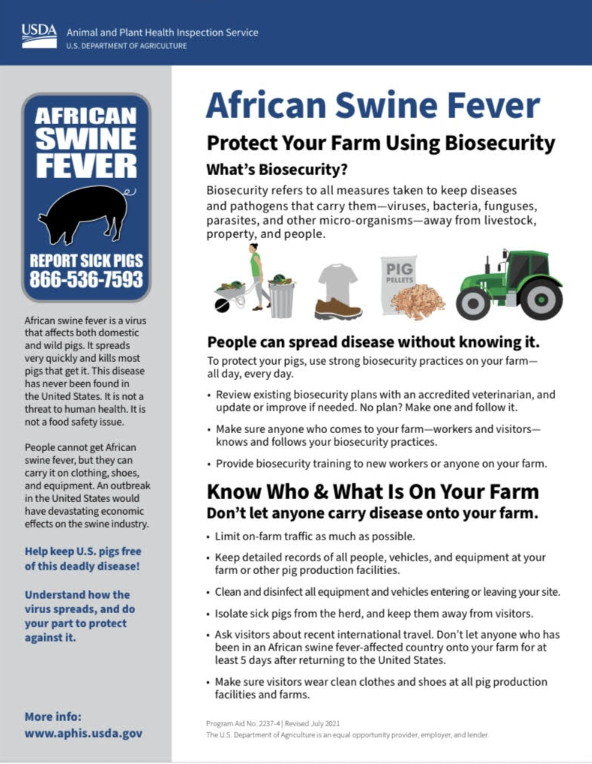
It's about ASF (African Swine Fever)
ASF is a highly dangerous and contagious deadly viral disease affecting domestic and feral swine of all ages. ASF is not a threat to human health and cannot be transmitted from pigs to humans. It is not a food safety issue.
ASF is found in countries around the world. More recently, it has spread to the Dominican Republic and Haiti. ASF has also spread through China, Mongolia, and Vietnam, as well as within parts of the European Union. It has never been found in the United States – and we want to keep it that way.
USDA's African swine fever program, Protect Our Pigs, provides the tools and resources you need to make sure that you are doing everything possible to keep swine healthy and reduce the risk of spreading ASF." From APHIS and the USDA
Remember…there is no vaccine for ASF.